Materia
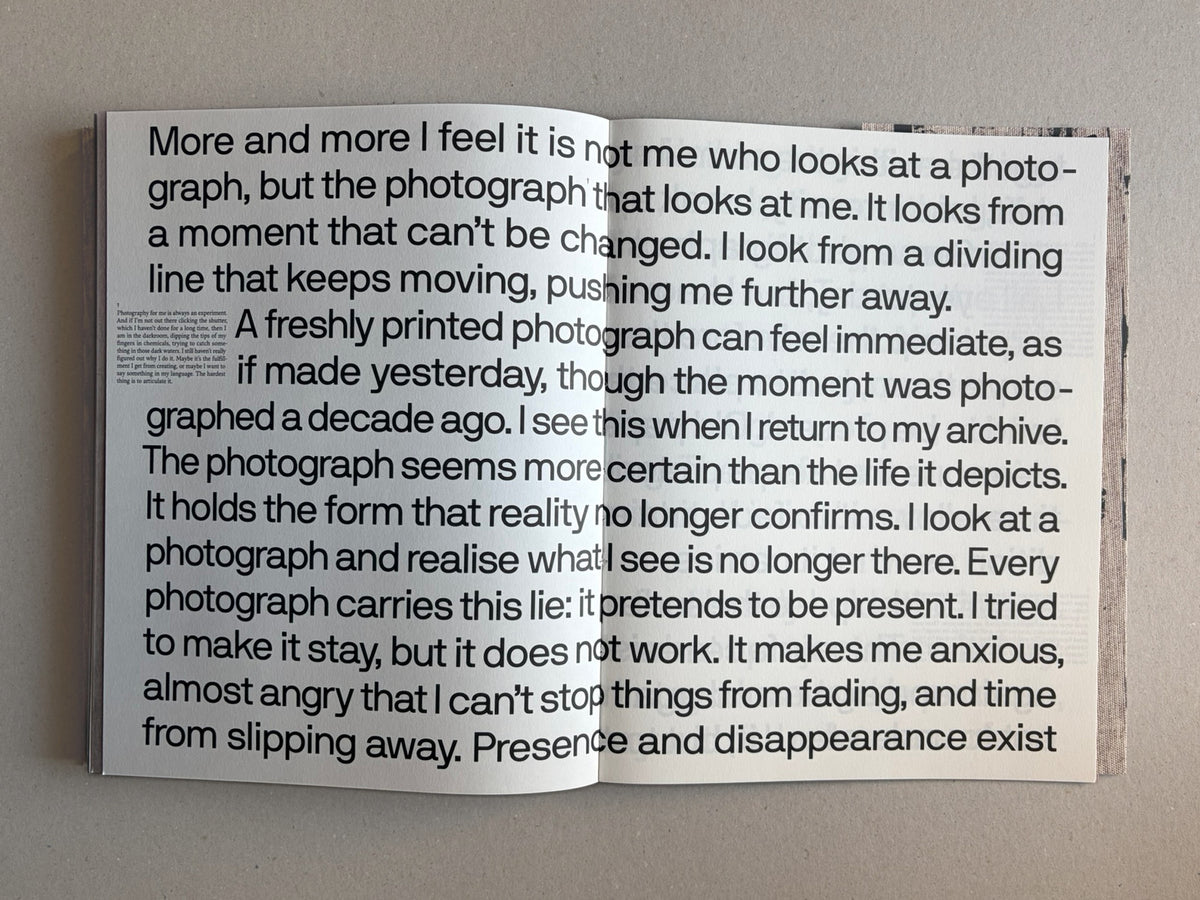
The starting point for Materia was a pair of portraits of the same man, taken by Vic Bakin ten years apart, in 2014 and 2024. Rather than illustrating the passage of time directly, the portraits reveal what had changed alongside what had strangely remained the same — an accumulation of time made visible within the image itself.
Around the same period, Bakin began printing on outdated Ukrainian photographic paper dating from the 1960s to the 2000s, each pack preserved under different conditions over the decades. Some sheets had faded, others carried mold, fingerprints, or almost no contrast left at all. In projecting his negatives onto this aged paper, he found a correspondence between the fragility of the photographic surface and the vulnerability of skin and body within the portraits themselves.
Vic Bakin:
"Over time, I found myself drawn to photographic materials that were already unstable, worn, or exhausted. Rather than resisting their imperfections, I learned to work with them. Somehow, I began to trust these damaged materials more than perfect ones. They seemed to carry time in a way that untouched surfaces could not."
As the images emerged — hesitant, faded, sometimes weakened, rarely behaving as expected — the instability of the paper came to matter as much as the photograph it carried. Repetition, chance, and variation became structural to the work, rather than incidental to it.
Vic Bakin:
"For me, thinking happens through making. I rarely begin with a clear concept. Instead, I make pictures first and then spend months trying to understand what they are telling me."
In Materia, the photographs admit their own instability. Bakin is interested in the moment a photograph becomes matter, and the moment matter begins to resist the image it is meant to carry. The result is a study of photography's own aging and failure — a project that does not illustrate time so much as reveal how time participates in the making of an image.
Published by Void in an edition of 1000 copies, softcover with a cloth dustjacket, 22 × 28 cm, 184 pages, with text in English. Photographs and text by Vic Bakin; edit and design by João Linneu and Myrto Steirou; calligraphy by Fernanda Fajardo; printing and binding by Future Format.
Vic Bakin (Viktor Bakin, b. 1984) is a self-educated Ukrainian photographer and artist based in Kyiv. His practice moves between portraiture, conceptual photography, and darkroom printing, examining how memory, environment, and material endurance shape contemporary Ukrainian experience. His series Epitome (2023) was named one of The Ones to Watch by the British Journal of Photography and received a LensCulture Photography Award; he is a two-time recipient of the Documenting Ukraine grant from the Institute for Human Sciences (IWM), Vienna. His first monograph, Epitome (Void, 2024), is a finalist for the Lucie Photo Book Prize 2025.