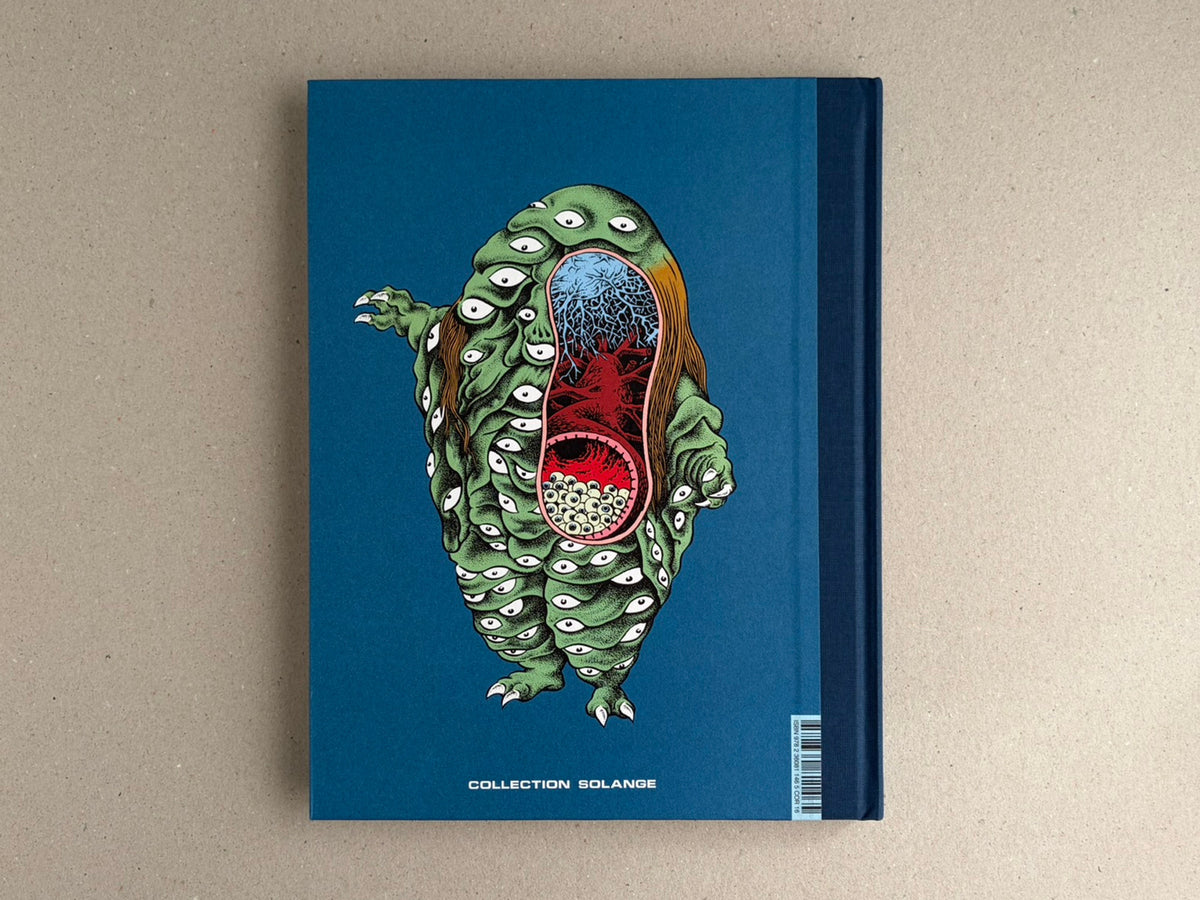
À l'intérieur des yokai — Inside the Yokai
Published by Éditions Cornélius in 2018, À l'intérieur des yokai (Inside the Yokai) collects approximately 85 anatomical cross-section drawings that Shigeru Mizuki produced in the 1960s. The premise is precise and deadpan: if yōkai are real, they require internal organs adapted to their particular capacities. Each drawing renders those organs with the same draftsmanly attention Mizuki brought to his manga backgrounds — detailed, systematic, and entirely straight-faced.
The subjects range across Japanese folklore. Fukurosagé, a tanuki from Nagano Prefecture, is shown to possess a stomach capable of converting food directly into sake. Mannendaké — a bamboo said to be ten thousand years old — uses finger-like appendages resembling syringes to extract the souls of travelers who stray too close. The accompanying texts, written by Mizuki and adapted into French by Jean-Louis Capron for this edition, maintain the same register as the drawings: matter-of-fact, quasi-scientific, and quietly absurd.
The volume belongs to the Collection Solange series and is printed in black and Pantone orange — a restrained palette suited to both the folkloric subject matter and the clinical format of the anatomical drawings. The binding is hardcover with a cloth spine (couverture cartonnée avec dos toilé). The book is a French-language publication, 96 pages, measuring 22.5 × 1.7 × 29 cm. ISBN 978-2360811465.
The related title Mononoke by Shigeru Mizuki is also available. Further titles in artist publications and illustrated books can be found in the Artbooks & Artist Publications collection.
Shigeru Mizuki (1922–2015)
Born Shigeru Mura on 8 March 1922 in Sakaiminato, Japan, Mizuki adopted his pen name early in his career. Drafted into the Imperial Army during World War II, he lost his left arm in combat — an experience that informed his later antimilitarist work, including Onward Towards Our Noble Deaths. He began in kamishibai (paper theater) before transitioning to manga in the late 1950s.
His interest in yōkai — supernatural creatures from Japanese folklore — was shaped in part by a woman he called "Nonnonba," whose oral storytelling during his childhood in Sakaiminato left a lasting impression. He combined that early exposure with extensive ethnographic research, producing a body of work that treated folklore as a serious subject rather than children's entertainment. His most widely known series, GeGeGe no Kitarō, brought yōkai into mainstream Japanese popular culture.
Mizuki's graphic style characteristically set cartoonish figures against highly detailed, almost photorealistic backgrounds, and his depictions of supernatural creatures drew on both visual imagination and folkloric precision. His work frequently engaged autobiography, history, and social critique. He died on 30 November 2015.